Cargo Control · Kinedyne
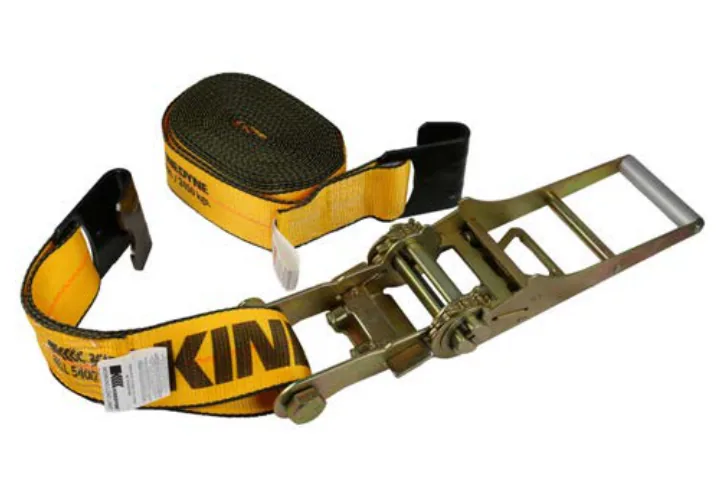
A ratchet strap is the general answer to flatbed tie-down: throw it over the load, hook both ends, and wind the ratchet until the webbing is tight. We stock Kinedyne in 2, 3 and 4 inch widths, in 27 and 30 foot assemblies, with flat hooks, wire hooks or chain anchors on the end.
Every assembly comes with an 18 inch fixed end as standard — the short tail the ratchet sits on — except the 3705‑2 and 3705‑3 chain anchor straps, which have a 32 inch fixed end. Other fixed-end lengths are a special order and we can get them.
Specification
- Polyester webbing
- Heat-treated carbon steel fittings
- 3:1 design factor
- Rated tag and stencil, in lb and kg
- 18” fixed end as standard
- Stenciled with the Kinedyne name and logo
Marked to
- DOT regulations
- WSTDA
- CHP
- North American Cargo Securement Standards
Which end fitting?
The hook is what decides whether the strap will actually attach to your trailer, and it is the part people most often order wrong. All three take the same webbing and the same ratchet.
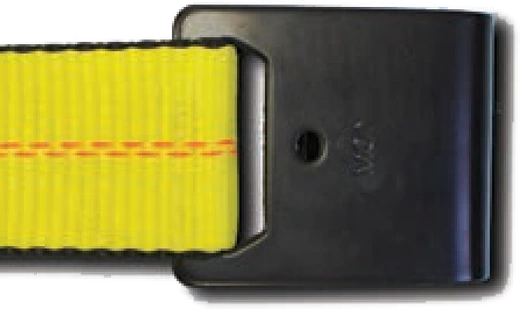
Flat HookA flat plate hook that lies against the rub rail or hooks into a stake pocket. The standard fitting on a flatbed and the one to order if nobody has told you otherwise — it sits flush, so it will not stand proud of the deck edge and catch on something.
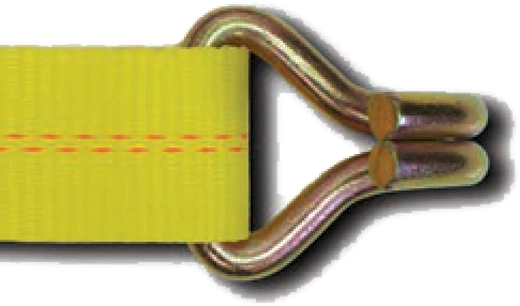
Wire HookA formed wire hook, narrower than a flat hook and easier to get into a stake pocket, a slot or a D‑ring that a flat hook will not fit. Lighter than the flat hook in the same size.
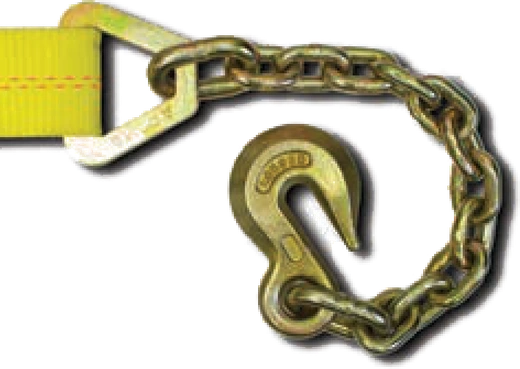
Chain AnchorA short length of Grade 70 chain with a grab hook, sewn to the strap in place of a hook. Use it where the anchor point is a long way from the load, where the strap would otherwise run over a sharp edge, or where you need to shorten the fixed end by grabbing a link.
Specifications
Tap Add on any line to build a quote list.
Standard — Kinedyne Gold
The everyday range, on Kinedyne’s gold webbing with the black edge. This is what goes out the door unless a job calls for something tougher.
| End Fitting | Width (in.) | Working Load Limit (lbs.) | Assembly Length (ft.) | Unit Weight (lbs.) | Stock No. | Quote |
|---|---|---|---|---|---|---|
| Flat Hook | 2 | 3,335 | 27 | 6.5 | 1400-250 | |
| Flat Hook | 2 | 3,335 | 30 | 6.7 | 1400-400 | |
| Flat Hook | 3 | 5,400 | 27 | 11.8 | 1400-1300 | |
| Flat Hook | 3 | 5,400 | 30 | 12.1 | 1400-1450 | |
| Flat Hook | 4 | 5,400 | 27 | 14.7 | 1400-1575 | |
| Flat Hook | 4 | 5,400 | 30 | 15.2 | 1400-1580 | |
| Wire Hook | 2 | 3,335 | 27 | 6.3 | 1400-1050 | |
| Wire Hook | 2 | 3,335 | 30 | 6.5 | 1400-1175 | |
| Wire Hook | 4 | 6,670 | 27 | 14.1 | 1400-1600 | |
| Wire Hook | 4 | 6,670 | 30 | 14.6 | 1400-1650 | |
| Chain Anchor | 2 | 3,335 | 27 | 11.0 | 1400-500 | |
| Chain Anchor | 2 | 3,335 | 30 | 11.2 | 1400-650 | |
| Chain Anchor | 3 | 5,400 | 27 | 15.8 | 1400-1500 | |
| Chain Anchor | 3 | 5,400 | 30 | 16.1 | 1400-1550 |
Rhino Max
Rhino Max is a heavier, abrasion-resistant webbing: roughly 30% thicker than the standard gold with a tougher surface, and it holds about 30% more tensile strength after severe abrasion. Order it for loads that chew straps up — anything with a cast or scaled surface, steel, or a job where the strap gets dragged across a deck. The 2 inch assembly is rated 4,000 lb rather than 3,335.
| End Fitting | Width (in.) | Working Load Limit (lbs.) | Assembly Length (ft.) | Unit Weight (lbs.) | Stock No. | Quote |
|---|---|---|---|---|---|---|
| Flat Hook | 2 | 4,000 | 27 | 6.4 | 1400-260 | |
| Flat Hook | 2 | 4,000 | 30 | 6.7 | 1400-410 |
Rhino Max is also made in wire hook and chain anchor, and in 4 inch. Call if you want one that is not listed — it is not a stock line for us but it is a normal order.
How many straps, and how strong?
Two separate requirements have to be met, and most people only think about one of them. The federal cargo securement rules set a minimum number of tiedowns based on how long and how heavy the article is, and separately a minimum total capacity based on what it weighs. Meeting one does not get you out of the other.
Minimum number of tiedowns
For an article that is not blocked or braced against forward movement:
| The article is… | Tiedowns, minimum |
|---|---|
| 5 ft or shorter and 1,100 lb or lighter | 1 |
| 5 ft or shorter and heavier than 1,100 lb | 2 |
| Longer than 5 ft but no more than 10 ft, any weight | 2 |
| Longer than 10 ft | 2, plus one more for every additional 10 ft or part of 10 ft |
Minimum total capacity
The working load limits of the tiedowns holding an article have to add up to at least half the weight of that article. How much each one contributes to that total depends on how it is run:
- Over the load, anchored both sides
- A tiedown that leaves an anchor point on one side of the trailer, passes over or around the load, and attaches to an anchor point on the other side counts its full working load limit.
- Anchored one side, or hooked to the load
- One that attaches to the article itself, or that comes back down to an anchor on the same side it started from, counts half its working load limit.
The working load limit of the assembly is the lowest rating in it — webbing, tensioner, hook, and the anchor point on the trailer. A 5,400 lb strap on a 3,000 lb rub rail is a 3,000 lb tiedown.
A worked example
A 6,000 lb crate, 12 ft long, sitting on a flatbed with nothing blocking it forward. Count: it is over 10 ft, so two tiedowns for the first 10 ft and one more for the remaining two — three straps. Capacity: the tiedowns have to total at least 3,000 lb; three 2 in straps thrown over the top and anchored on both sides give 3 × 3,335 = 10,005 lb. The count is what decides it here, not the capacity, and that is the usual result — people size the strap and forget to count them.
This is a plain-language summary of the general cargo securement rules in 49 CFR §393.100–393.114. Certain commodities — logs, dressed lumber, metal coils, paper rolls, concrete pipe, intermodal containers, vehicles, crushed cars, roll-off containers and large boulders — have their own rules that replace these. The driver and the carrier are responsible for the load; if you are not sure, call us before you load it, not after.
Reading the strap
- The tag
- A Tyvek tag carries the manufacturer’s name and the working load limit of the assembly in both pounds and kilograms. This is the number that counts toward your aggregate working load limit. A separate trilingual tag carries the warnings.
- The stencil
- The same information is printed along the webbing every 30 inches, so the rating survives a tag being torn off. A strap you cannot read the rating on is a strap you cannot legally count.
- The red lines
- The pair of red lines woven the length of the webbing is the WSTDA capacity indicator: the two together stand for 6,000 lb of webbing breaking strength per inch of width. They describe the webbing, not the assembly — the fittings and the tensioner are usually what sets the rating.
- Breaking strength
- These assemblies are built to a 3:1 design factor, so a 3,335 lb strap breaks at about 10,005 lb and a 4,000 lb Rhino Max at about 12,000 lb. Breaking strength is a test figure. Never work a strap above its working load limit.
When to take one out of service
Inspect every assembly before you use it. Take it out of service — and cut it up, so it does not find its way back onto a trailer — if you find any of this:
Webbing
- Any knot, anywhere in the strap
- Cuts, tears, holes or snags
- Broken or pulled stitching in a splice or an eye
- Melting, charring or weld spatter
- Acid, alkali or solvent burns
- Heavy abrasion, or webbing crushed flat and hard
- Embedded grit, chips or glass
- A tag and stencil you cannot read
Hardware
- A hook that is cracked, bent, stretched or worn thin
- A hook throat that has opened up
- A ratchet or winch that will not hold tension
- A bent handle or a worn or chipped pawl
- A frame that has been sprung by a cheater bar
- Corrosion deep enough to pit the metal
Use edge protection wherever the strap crosses anything that could cut or abrade it — that is a requirement, not a suggestion, and we stock corner protectors and sleeves for it. Never put a cheater bar on a ratchet handle. Polyester webbing is rated from −40°F to +194°F; store straps out of direct sun and away from chemicals. We inspect cargo control on site and cover tie-down securement in our rigging training.
Need a price or a lead time?
Most stocked items ship the same day from Hatfield. Call and we’ll confirm what’s on the shelf.