Wire Rope End Fittings
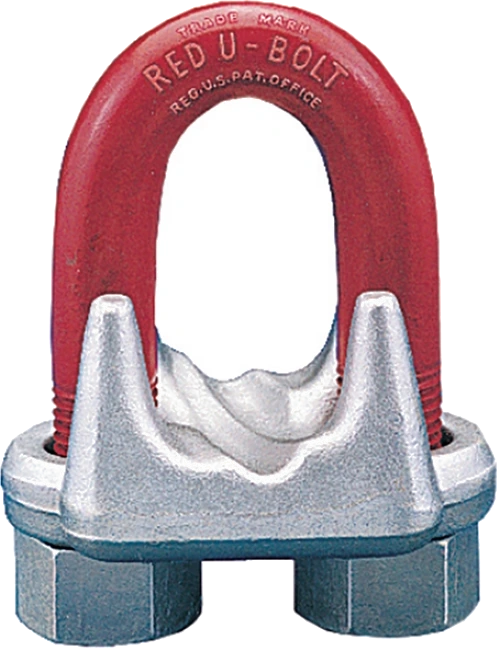
Features
- Each base has a Product Identification Code (PIC) for material traceability, the name CROSBY or CG, and a size forged into it.
- Based on the catalog breaking strength of wire rope, Crosby wire rope clips have an efficiency rating of 80% for 1/8” - 7/8” sizes, and 90% for sizes 1” through 3-1/2”.
- Entire Clip is Galvanized to resist corrosive and rusting action.
- Sizes 1/8” through 2-1/2” and 3” have forged bases.
- All Clips are individually bagged or tagged with proper application instructions and warning information.
- Clip sizes up through 1-1/2” have rolled threads.
- Meets or exceeds all requirements of ASME B30.26 including identification, ductility, design factor, proof load and temperature requirements. Importantly, these wire rope clips meet other critical performance requirements including fatigue life, impact properties and material traceability, not addressed by ASME B30.26.
- Look for the Red-U-Bolt®, your assurance of Genuine Crosby Clips.
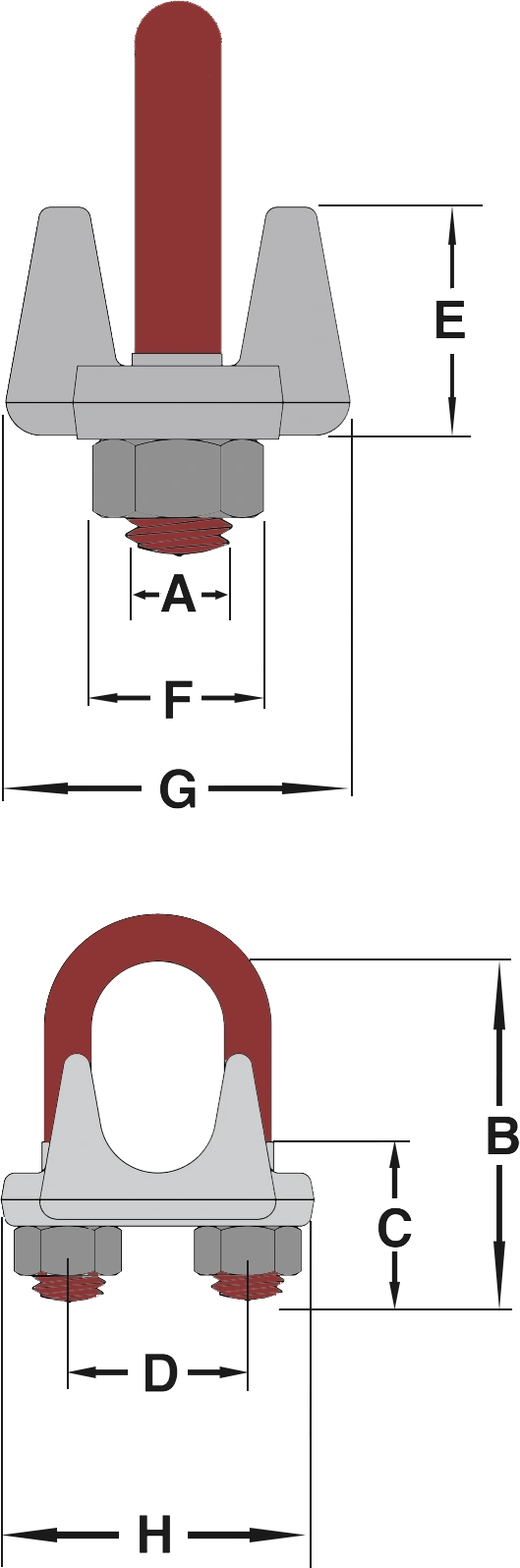
Specifications
Tap Add on any line to build a quote list.
| Rope Size (in.) | (mm) | G-450 Stock No. | Std. Package Qty. | Weight Per 100 (lbs.) | Dimensions (in.) A | B | C | D | E | F | G | H | Quote |
|---|---|---|---|---|---|---|---|---|---|---|---|---|---|
| 1/8 | 3-4 | 1010015 | 100 | 6 | .22 | .72 | .44 | .47 | .37 | .38 | .81 | .99 | |
| 3/16 | 5 | 1010033 | 100 | 10 | .25 | .97 | .56 | .59 | .50 | .44 | .94 | 1.18 | |
| 1/4 | 6-7 | 1010051 | 100 | 19 | .31 | 1.03 | .50 | .75 | .66 | .56 | 1.19 | 1.43 | |
| 5/16 | 8 | 1010079 | 100 | 28 | .38 | 1.38 | .75 | .88 | .73 | .69 | 1.31 | 1.66 | |
| 3/8 | 9-10 | 1010097 | 100 | 48 | .44 | 1.50 | .75 | 1.00 | .91 | .75 | 1.63 | 1.94 | |
| 7/16 | 11 | 1010113 | 50 | 78 | .50 | 1.88 | 1.00 | 1.19 | 1.13 | .88 | 1.91 | 2.28 | |
| 1/2 | 12-13 | 1010131 | 50 | 80 | .50 | 1.88 | 1.00 | 1.19 | 1.13 | .88 | 1.91 | 2.28 | |
| 9/16 | 14-15 | 1010159 | 50 | 109 | .56 | 2.25 | 1.25 | 1.31 | 1.34 | .94 | 2.06 | 2.50 | |
| 5/8 | 16 | 1010177 | 50 | 110 | .56 | 2.25 | 1.25 | 1.31 | 1.34 | .94 | 2.06 | 2.50 | |
| 3/4 | 18-20 | 1010195 | 25 | 142 | .62 | 2.75 | 1.44 | 1.50 | 1.39 | 1.06 | 2.25 | 2.84 | |
| 7/8 | 22 | 1010211 | 25 | 212 | .75 | 3.12 | 1.62 | 1.75 | 1.58 | 1.25 | 2.44 | 3.16 | |
| 1 | 24-26 | 1010239 | 10 | 252 | .75 | 3.50 | 1.81 | 1.88 | 1.77 | 1.25 | 2.63 | 3.47 | |
| 1-1/8 | 28-30 | 1010257 | 10 | 283 | .75 | 3.88 | 2.00 | 2.00 | 1.91 | 1.25 | 2.81 | 3.59 | |
| 1-1/4 | 32-34 | 1010275 | 10 | 438 | .88 | 4.44 | 2.22 | 2.34 | 2.17 | 1.44 | 3.13 | 4.13 | |
| 1-3/8 | 36 | 1010293 | 10 | 442 | .88 | 4.44 | 2.22 | 2.34 | 2.31 | 1.44 | 3.13 | 4.19 | |
| 1-1/2 | 38 | 1010319 | 10 | 544 | .88 | 4.94 | 2.38 | 2.59 | 2.44 | 1.44 | 3.41 | 4.44 | |
| 1-5/8 | 41-42 | 1010337 | Bulk | 704 | 1.00 | 5.31 | 2.62 | 2.75 | 2.66 | 1.63 | 3.63 | 4.75 | |
| 1-3/4 | 44-46 | 1010355 | Bulk | 934 | 1.13 | 5.75 | 2.75 | 3.06 | 2.92 | 1.81 | 3.81 | 5.24 | |
| 2 | 48-52 | 1010373 | Bulk | 1300 | 1.25 | 6.44 | 3.00 | 3.38 | 3.03 | 2.00 | 4.44 | 5.88 | |
| 2-1/4 | 56-58 | 1010391 | Bulk | 1600 | 1.25 | 7.13 | 3.19 | 3.88 | 3.19 | 2.00 | 4.56 | 6.38 | |
| 2-1/2 | 62-65 | 1010417 | Bulk | 1900 | 1.25 | 7.69 | 3.44 | 4.13 | 3.69 | 2.00 | 4.69 | 6.63 | |
| 2-3/4 | 68-72 | 1010435 | Bulk | 2300 | 1.25 | 8.31 | 3.56 | 4.38 | 4.88 | 2.00 | 5.00 | 6.88 | |
| 3 | 75-78 | 1010453 | Bulk | 3100 | 1.50 | 9.19 | 3.88 | 4.75 | 4.44 | 2.38 | 5.31 | 7.61 | |
| 3-1/2 | 85-90 | 1010426 | Bulk | 4000 | 1.50 | 10.75 | 4.50 | 5.50 | 6.00 | 2.38 | 6.19 | 8.38 |
Fitting them correctly
A wire rope clip termination is only worth what the installation is worth. Fitted properly, a loop or thimble eye made with these clips is rated at 80% of the rope’s catalog breaking force in sizes 1/8” through 7/8”, and 90% in sizes 1” through 3‑1/2”. Fitted the wrong way round it is worth very little, and that is the failure we see most.
The single thing to remember: the U‑bolt goes over the dead end — the short tail — and the saddle sits on the live end that carries the load. Riggers say never saddle a dead horse, and it is worth saying out loud every time, because a clip fitted backwards looks very nearly right.
How many clips, how much turnback
Clip size matches rope size throughout, so there is one size to look up. Read the notes under the table as well as the numbers — two of the three change the answer.
| Clip / Rope Size (in.) | Minimum No. of Clips | Rope to Turn Back (in.) | Torque (ft. lbs.) |
|---|---|---|---|
| 1/8 | 2 | 3-1/4 | 4.5 |
| 3/16 | 2 | 3-3/4 | 7.5 |
| 1/4 | 2 | 4-3/4 | 15 |
| 5/16 | 2 | 5-1/4 | 30 |
| 3/8 | 2 | 6-1/2 | 45 |
| 7/16 | 2 | 7 | 65 |
| 1/2 | 3 | 11-1/2 | 65 |
| 9/16 | 3 | 12 | 95 |
| 5/8 | 3 | 12 | 95 |
| 3/4 | 4 | 18 | 130 |
| 7/8 | 4 | 19 | 225 |
| 1 | 5 | 26 | 225 |
| 1-1/8 | 6 | 34 | 225 |
| 1-1/4 | 7 | 44 | 360 |
| 1-3/8 | 7 | 44 | 360 |
| 1-1/2 | 8 | 54 | 360 |
| 1-5/8 | 8 | 58 | 430 |
| 1-3/4 | 8 | 61 | 590 |
| 2 | 8 | 71 | 750 |
| 2-1/4 | 8 | 73 | 750 |
| 2-1/2 | 9 | 84 | 750 |
| 2-3/4 | 10 | 100 | 750 |
| 3 | 10 | 106 | 1200 |
| 3-1/2 | 12 | 149 | 1200 |
Add one clip if a pulley (sheave) is used in place of a thimble for the turnback. If you use more clips than the table shows, increase the turnback proportionately. The torque figures assume threads that are clean, dry and free of lubrication — a lubricated thread reaches the same torque at a lower clamping force, which is not what you want.
Installation
- 1
Turn back the amount of rope the table gives for your size. Apply the first clip one base width from the dead end of the rope. Apply the U‑bolt over the dead end and the saddle on the live end — never saddle a dead horse. Tighten the nuts evenly with a torque wrench, alternating from one to the other, until you reach the recommended torque.

Figure 1 - 2
Apply the second clip as near the loop or thimble as possible. Tighten the nuts evenly, alternating, until you reach the recommended torque. Where only two clips are required this is the last one; where more are required, turn the nuts on this second clip firmly but do not tighten it yet.

Figure 2 - 3
With three or more clips, space the additional ones equally between the first two, taking up rope slack as you go. Tighten the nuts on each clip evenly, alternating from one nut to the other, until each reaches the recommended torque.

Figure 3 - 4
Where a pulley (sheave) is used in place of a thimble, add one extra clip — and space the clips as shown, one clip base width apart.
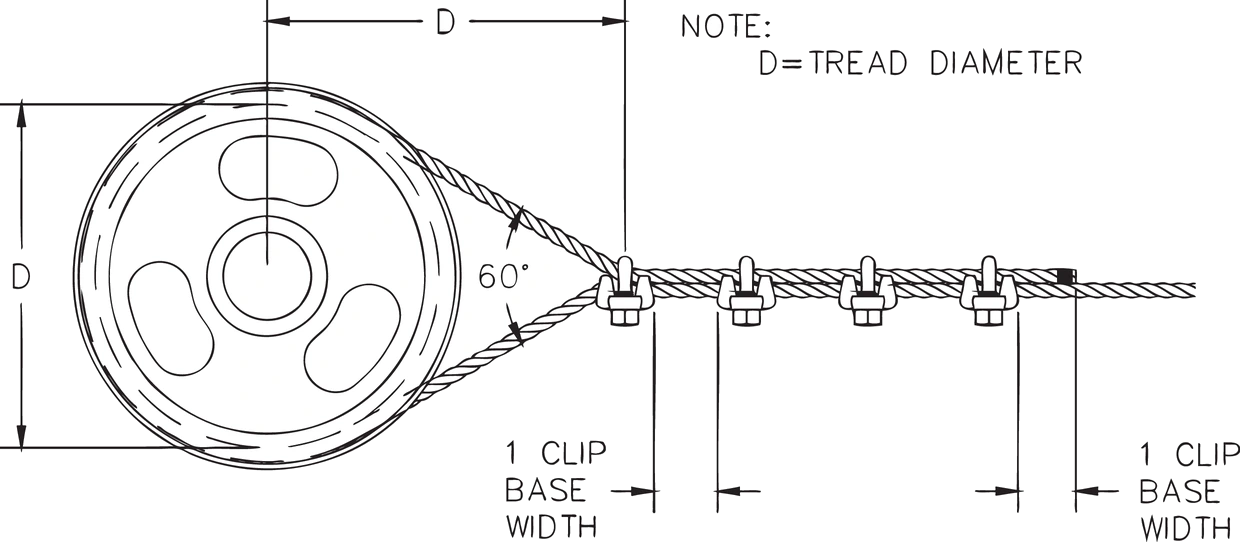
Figure 4
Splicing two ropes
- 5
The preferred way to splice two ropes together is interlocking turnback eyes with thimbles, using the recommended number of clips on each eye.

Figure 5 - 6
The alternative uses twice the number of clips a turnback termination would take. The rope ends lie parallel to each other, overlapping by twice the turnback amount, with the minimum number of clips installed on each dead end. Spacing, torque and every other instruction above still apply.
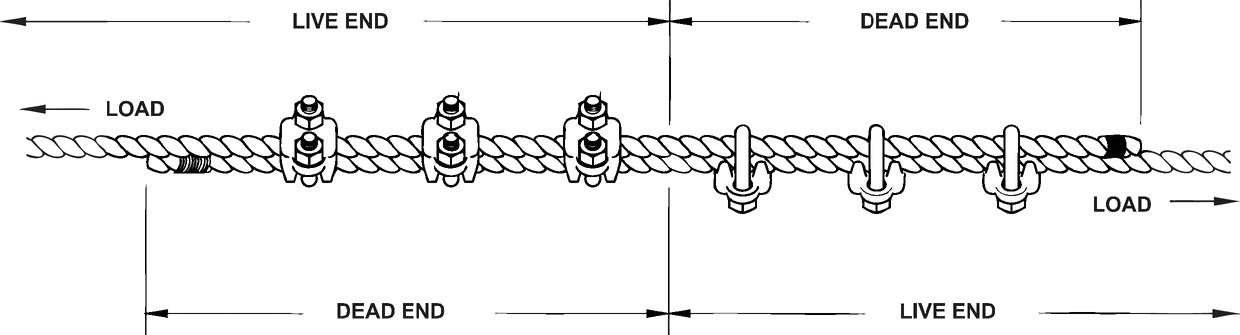
Figure 6
Before you trust it
Apply a first load equal to or greater than the load the assembly will see in service. Then check the nuts again and re-tighten to the recommended torque — the rope settles and compresses under that first load, and the clips go slack. Skipping this is how a correctly fitted termination still ends up loose.
Keep checking them. In line with good rigging practice, a wire rope end termination should be inspected periodically for wear, abuse and general adequacy.
What the clip count assumes
- Rope class
- The numbers above are for RRL or RLL wire rope, 6×19 or 6×37 Class, fibre core or IWRC, in IPS, XIP or XXIP. They also cover rotation-resistant RRL 8×19 Class and 19×7 Class in IPS, XIP or XXIP, in sizes 1‑1/2” and smaller.
- Seale construction
- For Seale or a similar large outer wire construction in the 6×19 Class at 1” and larger, add one clip.
- Anything else
- For other classes of rope, ask — we will get an answer from Crosby Engineering rather than guess at one.
- Whose call it is
- The style of termination used for any application is the obligation of the user. For OSHA construction work, see OSHA 1926.251.
Need a price or a lead time?
Most stocked items ship the same day from Hatfield. Call and we’ll confirm what’s on the shelf.