Wire Rope Slings
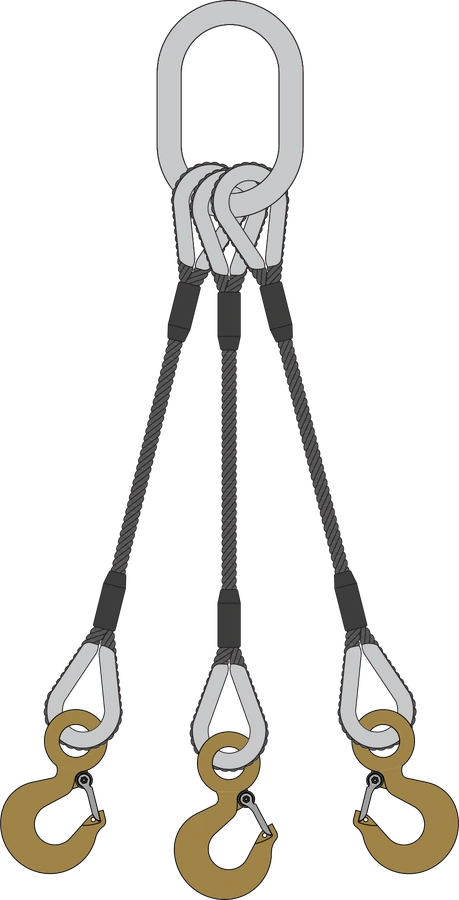
Three legs from one master link, so the load is picked at three points instead of one. That is what stops a long or awkward load from swinging, tipping or spinning as it comes off the ground.
The catch is that legs at an angle carry more than their share of the weight, so the capacity table is by angle rather than a single number. Read the column that matches how you will actually rig it — and measure the angle up from the horizontal, not down from the vertical.
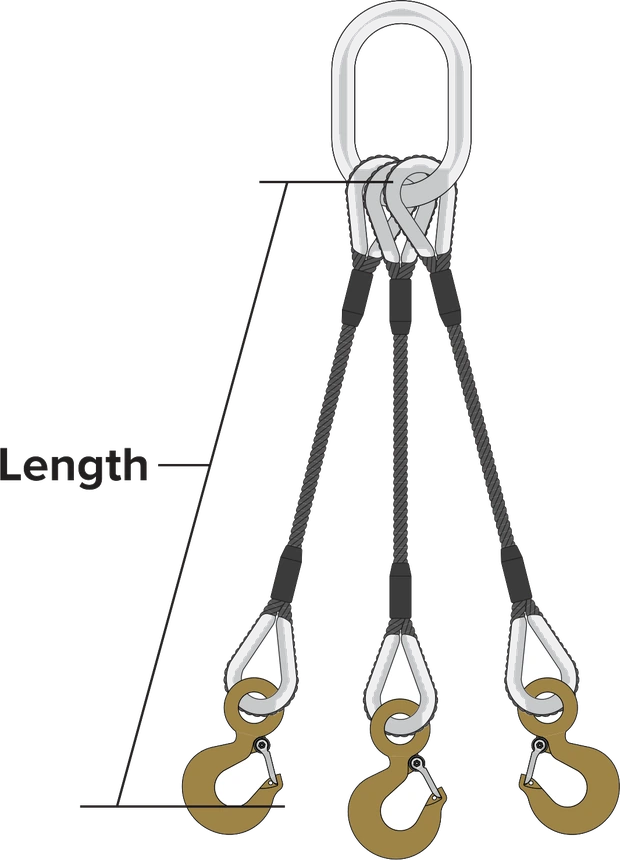
Length on a bridle is measured from the bearing point of the master link to the bearing point of the hook, as the drawing shows. Tell us that and the rope size, and we will build it.
Features
- Flemished eye splice
- Sizes available from 1/4” to 2”
- 6×19 & 6×37 class bright EIPS IWRC wire rope
- Galvanized & stainless steel wire rope available on request
- Heavy duty stainless steel tag
- 5:1 design factor
- Proof testing available on request
- Made in Hatfield, PA
How to order
- Specify wire rope size
- Specify leg length
- Specify end fittings
Standard configurations
Both are made to order in any leg length. The difference is only what is on the bottom of the legs.
13-9-3Master link + alloy eye hooks 13-9-2Master link + thimble eyes
Rated capacities
Every bridle is made to order — tap Add on the size you want and tell us the length in the quote.
Tons of 2,000 lb, at a 5:1 design factor. The master link and hook sizes are what we fit as standard at that rope size.
| Rope Dia. (in.) | 60° | 45° | 30° | Master Link (in.) | Eye Hooks | Quote |
|---|---|---|---|---|---|---|
| 1/4 | 1.7 | 1.4 | .97 | 3/4 | 0.75 ton S-320C | |
| 3/8 | 3.7 | 3.0 | 2.2 | 1 | 1.5 ton S-320C | |
| 1/2 | 6.6 | 5.4 | 3.8 | 1-1/4 | 3 ton S-320C | |
| 5/8 | 10.0 | 8.3 | 5.9 | 1-1/4 | 5 ton S-320A | |
| 3/4 | 15.0 | 12 | 8.4 | 1-1/2 | 7 ton S-320A | |
| 7/8 | 20.0 | 16 | 11 | 1-1/2 | 11 ton S-320A | |
| 1 | 26.0 | 21 | 15 | 1-3/4 | 11 ton S-320A | |
| 1 1/8 | 31.0 | 26 | 18 | 2 | 15 ton S-320A | |
| 1 1/4 | 38.0 | 31 | 22 | 2 | 15 ton S-320A | |
| 1 3/8 | 46.0 | 38 | 27 | 2-1/4 | 22 ton S-320A | |
| 1 1/2 | 55.0 | 45 | 32 | 2-1/2 | 22 ton S-320A | |
| 1-3/4 | 74 | 60 | 42 | 2-3/4 | 30 ton S-320A | |
| 2 | 95 | 78 | 55 | 3 | 37 ton S-320A |
Fabricated in Hatfield and proof tested in house. Tell us the size, the length and the fittings and we will build it; if you would rather tell us the load and the geometry, we will work out the sling.
Sling angle is the thing that catches people
The moment a leg is not vertical it carries more tension than its share of the load, and the flatter the angle the worse it gets. The angle that matters is measured from the horizontal — from the top of the load up to the leg — not from the vertical, and confusing the two is the single most common mistake in rigging.
| Angle from horizontal | Leg carries | What that means |
|---|---|---|
| 90° | 100% | Straight vertical lift. Nothing lost. |
| 60° | 87% | The usual working angle, and what the first column of the table assumes. |
| 45° | 71% | Legs spread as wide as they are tall. |
| 30° | 50% | Half your capacity gone. The flattest angle you should ever work at. |
| Under 30° | — | Not to be used. Tension climbs so steeply that a small error in the angle is a large error in the load. |
A quick way to picture it: if the legs spread out as wide as the sling is tall, you are at about 45° and each leg is doing 1.4 times the work it would do straight down. The fix is almost always a longer sling or a spreader beam, not a bigger one.
The rated capacities in the table already have the angle worked in — the 45° column is the capacity of the assembly at 45°, not something to reduce again. Just read the column that matches how you will rig it.
D/d ratio — what you bend it around
Wire rope loses strength when it is bent. How much depends on the ratio between the diameter of what you bend it over (D) and the diameter of the rope itself (d). Bend a 1/2 inch sling round a 5 inch pin and D/d is 10; round a 1 inch shackle pin and it is 2, and you have thrown away roughly a quarter of the sling.
| D/d | Strength retained |
|---|---|
| 8 or more | 95% |
| 6 | 92% |
| 4 | 87% |
| 2 | 75% |
| 1 | 50% |
This is why a basket capacity comes with a condition attached, and why a sharp corner is worse than a small pin — a square edge is effectively a D/d of nearly nothing. Pad it, or use a softener.
When to take a sling out of service
Look at a sling before every lift, and have it inspected properly at least once a year — more often if it is working hard. Remove it from service and destroy it if you find any of this:
The rope
- Ten randomly distributed broken wires in one rope lay
- Five broken wires in one strand in one lay
- Wear or scraping of one third the original diameter of an outside wire
- Kinking, crushing, birdcaging or any distortion of the rope structure
- Heat damage — melting, charring, or weld spatter
- Severe corrosion, or pitting you can feel
- A section that has stretched noticeably thinner than the rest
The ends and fittings
- Broken or worn wires at or near an end attachment
- A cracked, deformed or worn end fitting
- A hook opened past the manufacturer’s limit, or twisted
- A missing or unreadable identification tag
- A sling that has been shock loaded
- Any repair not made by a qualified person
This follows ASME B30.9. A sling with no legible tag cannot be used, whatever condition the rope is in — and retagging is not something to do from memory, because the tag has to match what the sling actually is. Bring it to us and we will identify it, test it and tag it, or tell you plainly that it should be replaced. We also inspect on site and cover all of this in rigging training.
Need a price or a lead time?
Most stocked items ship the same day from Hatfield. Call and we’ll confirm what’s on the shelf.