Wire Rope Slings
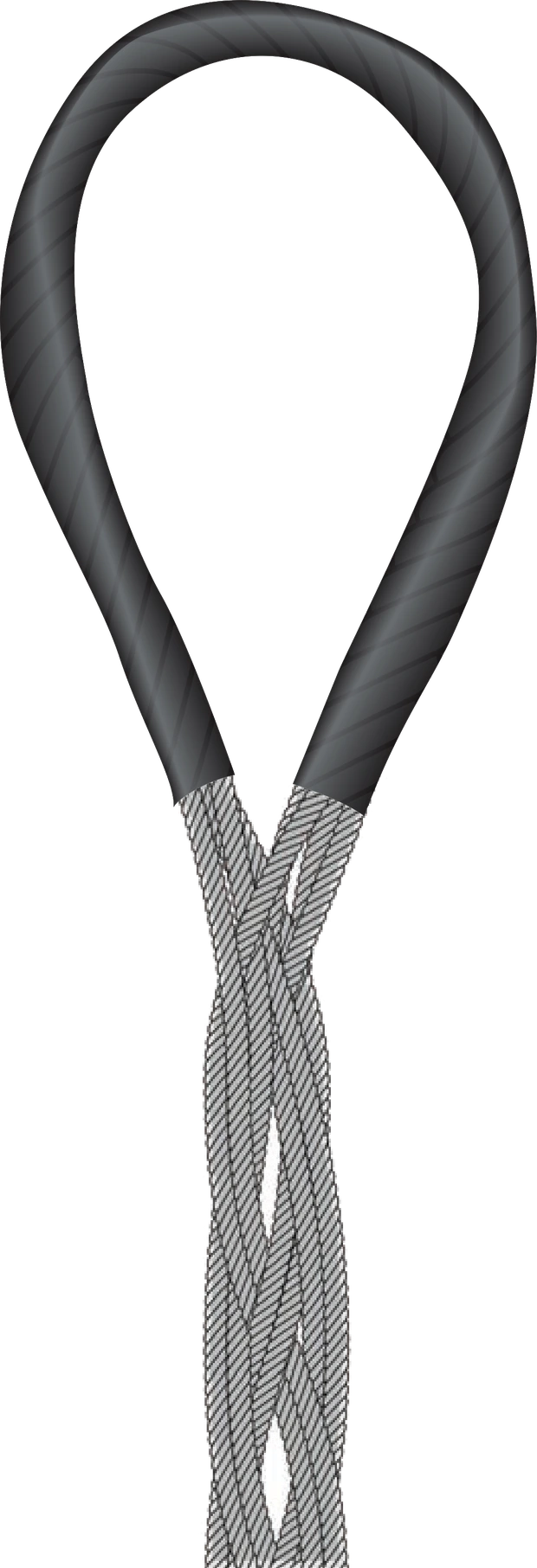
A braided sling is several ropes braided into one body. It is not the same thing as a bigger rope: braiding buys flexibility, and flexibility is what lets a sling lie down over an awkward load, grip it, and bend tighter than a single rope of the same capacity ever could.
It also makes a sling much harder to kill. Damage that would be a serious defect in a single rope is shared across the parts of a braid, which is why braided slings survive in mill and foundry work that eats conventional slings.
Three, six or eight part. More parts means more capacity at the same component rope size, a fatter and heavier sling, and a higher price.
Why braided
- Far more flexible than a single rope of the same capacity
- Lies down over the load and grips it
- Takes a tighter bend
- Damage is shared across the parts
- Wrapped eyes available on request
The trade
- Bulkier and heavier to handle
- Costs more than a single leg sling
- Harder to inspect — more surface to look at
Three, six or eight part
All three are made from the same 6×19 and 6×37 class EIPS IWRC rope, to the same 5:1 design factor. What changes is how many ropes go into the braid.
| Construction | 1/2” rope, vertical | Sling dia. | Where it fits |
|---|---|---|---|
| Three part | 6.4 ton | 1” | The lightest braid, and the one to reach for when you want flexibility rather than capacity. |
| Six part | 12 ton | 1-3/4” | The workhorse. Roughly double the three part at the same rope size. |
| Eight part | 16 ton | 2-1/4” | Heavy mill work. Sizes run to 1” component rope rather than 2”. |
Capacities shown are vertical hitch at 1/2 inch component rope, for comparison only — each page carries the full table. Note that the three part range goes up to 2 inch component rope while the six and eight part stop at 1 inch.
Vertical, choker, basket
The same sling has three ratings depending on how you hitch it, and the table gives all three. Read the column that matches what you are actually going to do.
- Vertical
- Straight pull, hook at the top, load at the bottom. The sling’s full rating, and the number every other hitch is worked out from. A single vertical leg lets the load spin, so it wants a tag line or a second leg.
- Choker
- The sling passes round the load and back through its own eye. Roughly 75% of vertical, because the body of the sling is bent hard where it passes through the eye. It grips, so it is what you use on a bundle or anything that could slide — but it does not make a bundle safe on its own.
- Basket
- Both eyes on the hook, the load cradled in the bight. Twice vertical when the legs hang straight down, because two legs share the load — and less than that the moment they splay, which is what the angle table below is about.
Basket capacities on this page assume the load is over a pin or a hook of adequate diameter. Bend a sling round something too small and you lose strength fast; that is the D/d ratio, and it is set out below.
Sling angle is the thing that catches people
The moment a leg is not vertical it carries more tension than its share of the load, and the flatter the angle the worse it gets. The angle that matters is measured from the horizontal — from the top of the load up to the leg — not from the vertical, and confusing the two is the single most common mistake in rigging.
| Angle from horizontal | Leg carries | What that means |
|---|---|---|
| 90° | 100% | Straight vertical lift. Nothing lost. |
| 60° | 87% | The usual working angle, and what the first column of the table assumes. |
| 45° | 71% | Legs spread as wide as they are tall. |
| 30° | 50% | Half your capacity gone. The flattest angle you should ever work at. |
| Under 30° | — | Not to be used. Tension climbs so steeply that a small error in the angle is a large error in the load. |
A quick way to picture it: if the legs spread out as wide as the sling is tall, you are at about 45° and each leg is doing 1.4 times the work it would do straight down. The fix is almost always a longer sling or a spreader beam, not a bigger one.
The rated capacities in the table already have the angle worked in — the 45° column is the capacity of the assembly at 45°, not something to reduce again. Just read the column that matches how you will rig it.
When to take a sling out of service
Look at a sling before every lift, and have it inspected properly at least once a year — more often if it is working hard. Remove it from service and destroy it if you find any of this:
The rope
- Ten randomly distributed broken wires in one rope lay
- Five broken wires in one strand in one lay
- Wear or scraping of one third the original diameter of an outside wire
- Kinking, crushing, birdcaging or any distortion of the rope structure
- Heat damage — melting, charring, or weld spatter
- Severe corrosion, or pitting you can feel
- A section that has stretched noticeably thinner than the rest
The ends and fittings
- Broken or worn wires at or near an end attachment
- A cracked, deformed or worn end fitting
- A hook opened past the manufacturer’s limit, or twisted
- A missing or unreadable identification tag
- A sling that has been shock loaded
- Any repair not made by a qualified person
This follows ASME B30.9. A sling with no legible tag cannot be used, whatever condition the rope is in — and retagging is not something to do from memory, because the tag has to match what the sling actually is. Bring it to us and we will identify it, test it and tag it, or tell you plainly that it should be replaced. We also inspect on site and cover all of this in rigging training.
Need a price or a lead time?
Most stocked items ship the same day from Hatfield. Call and we’ll confirm what’s on the shelf.